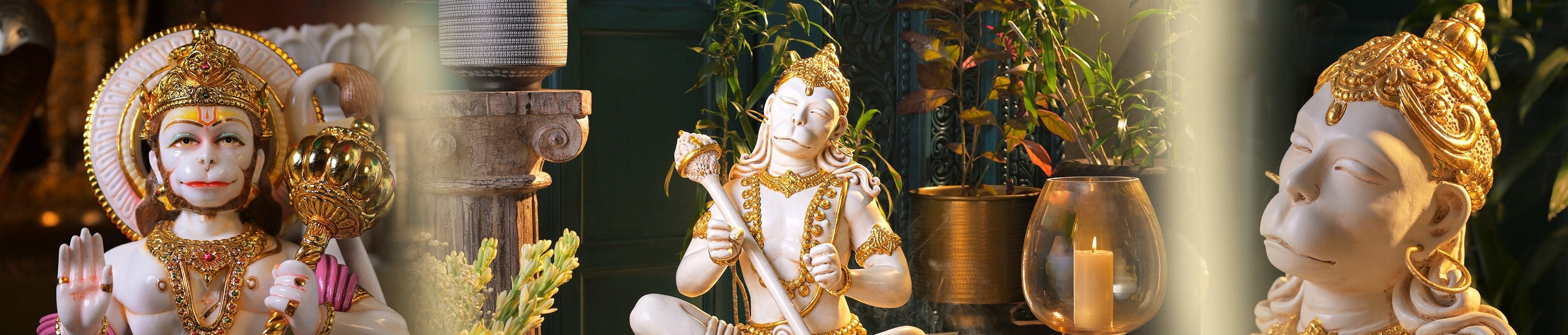
Shop Hanuman Ji Statue Online in Marble & Brass
Lord Hanuman is one of the most revered figures in Hindu tradition, traditionally associated with devotion, courage, strength, discipline, loyalty, and service. His presence in Indian homes often reflects these qualities through carefully chosen forms of devotional art.
A Hanuman statue has a lot of meaning in how it is made. You can see it in the pose, the face, the hand movements, and the signs shown on it. Even the material and the finishing matter. The Nandi by Kuber Hanuman Collection is made with prayer use in mind. It fits a prayer room, a home temple, a place to meditate, a living area, an office, or a gift for someone else.
Many people start by checking the size and the overall look. After that, they look more closely at the shape and the quality of the work.
When someone keeps a devotional idol in daily practice, it can turn into a steady part of family prayers. It is not just something used now and then for decoration.
Understanding the Significance of a Hanuman Statue
Hanuman's character in Hindu tradition is closely connected with devotion to Lord Rama, courage in difficult circumstances, physical strength, humility, discipline, and selfless service. Different artistic forms highlight different aspects of this identity.
A Hanuman statue may appear seated, standing, kneeling, carrying symbols associated with his stories, or displaying a gesture of devotion. The chosen form affects both its cultural meaning and visual character.
What Hanuman's Posture and Expression Represent
Posture, facial expression, hand gestures, ornaments, and accompanying elements contribute to how an idol is understood. A calm expression and composed posture can suit a contemplative devotional setting, while a dynamic form can communicate strength and readiness for service.
The details matter. A balanced face, clearly defined features, and proportionate limbs help preserve the character of the traditional representation.
Choosing a Hanuman Ji Murti for a Home or Prayer Space
A Hanuman Ji murti can suit a home temple, prayer room, meditation area, living space, or office when its scale and form correspond with the surroundings. Smaller idols often work well on compact prayer shelves, while larger pieces require sufficient visual and physical space.
Gifting introduces another consideration. A balaji murti may be chosen for housewarmings, festivals, family occasions, or personal devotional collections. Purpose comes first; size, material, posture, and finish follow.
What to Look for When Buying a Hanuman Idol
When selecting a Hanuman idol, practical details deserve attention:
- Material: Consider durability, weight, texture, and maintenance.
- Craftsmanship: Look for clean sculptural lines and consistent detailing.
- Expression: Facial features should appear balanced and purposeful.
- Proportion: Limbs, torso, head, ornaments, and base should work together.
- Stability: The base should provide secure support.
- Finish: Surface treatment should retain important sculptural details.
- Size: The idol should relate comfortably to the intended space.
A common hesitation is choosing between elaborate ornamentation and a simpler form. Often, proportion and workmanship prove more useful than visual complexity.
Panchmukhi Hanuman Idol and the Meaning Behind Its Form
The panchmukhi hanuman idol represents Hanuman in a five-faced form associated with a well-known episode in devotional tradition. Each face has its own identity, making this representation distinct from single-faced Hanuman forms.
Its significance is best understood through the traditional narrative and iconography rather than as a decorative variation. Facial arrangement, expression, ornaments, and the sculptor's handling of multiple forms require particular attention.
Choosing a Panchmukhi Hanuman Idol for Devotional Spaces
A panchmukhi hanuman idol requires enough surrounding space for its multiple faces and details to remain visually clear. Scale, proportion, material, and finish become especially important because crowded placement can make the sculptural arrangement difficult to appreciate.
Marble Hanuman Murti Designs and Traditional Craftsmanship
Marble has a long association with Indian sculptural traditions and is valued for its smooth surface and suitability for detailed carving. Light-coloured marble can make facial features, folds, ornaments, and subtle surface work particularly visible.
When considering a marble hanuman murti, attention should go to carving precision, facial symmetry, proportion, surface finishing, and the treatment of smaller elements. Marble also requires suitable handling and regular care to preserve its appearance.
How Material Changes the Character of a Devotional Idol
Different materials create different visual qualities. Marble tends toward a clean sculptural appearance, while metal provides a stronger sense of weight and surface character.
A marble hanuman murti may suit a bright prayer room or refined home setting where carved details remain visible. In another devotional collection, a balaji idol may sit alongside other traditional forms while retaining its own distinct identity.
Brass Hanuman Idol Options for Traditional and Contemporary Spaces
Brass has a familiar place in Indian devotional art, particularly in traditional homes and temple settings. Its warm metallic appearance can highlight sculptural contours, ornaments, facial features, and smaller details.
A brass hanuman idol can work within both traditional and contemporary interiors when its scale and finish relate naturally to the setting. Weight and stability are practical advantages, while surface maintenance remains an important consideration.
Selecting the Right Size, Finish and Level of Detail
For a brass hanuman idol, room size, placement surface, height, width, finish, and ornamentation all influence suitability. A heavily detailed piece needs sufficient space around it; a restrained form may integrate more easily into a compact prayer area.
And the right scale often becomes clear only when the surrounding space is considered as carefully as the idol itself.
Hanuman Idols for Gifting and Devotional Spaces
Hanuman idols are commonly considered for housewarming gifts, religious festivals, family occasions, personal prayer spaces, and cultural collections. The choice can reflect the recipient's space, preferred material, and familiarity with particular forms.
A devotional gift can carry personal and cultural meaning without requiring claims about guaranteed outcomes. For a family already maintaining a ramdarbar murti, a Hanuman representation may also sit naturally within a broader devotional collection.
When a Simple Idol Becomes a Lasting Choice
Purchasing decisions often change during comparison. An elaborate design may attract attention initially, but a simpler idol can prove more suitable once its proportions, expression, and craftsmanship are considered alongside the prayer space.
Sometimes the deciding detail is a face, a stable base, or the way the finish handles light—not the amount of ornamentation.
Finding a Hanuman Idol That Fits the Space and Purpose
Selecting a hanuman statue becomes clearer when purpose, location, size, material, artistic style, posture, expression, detailing, and maintenance are considered together. A panchmukhi hanuman idol may require more visual room, while a compact form can suit a smaller prayer setting.
Traditional devotional art also sits comfortably beside contemporary furnishings. A lord shiva statue or other Hindu idol may share a collection without making the setting feel crowded.
The strongest choice is often the form that feels appropriate to its intended setting rather than the largest or most elaborate design. The Hanuman Collection at Nandi By Kuber reflects this balance between traditional representation, considered proportions, and craftsmanship.